
How to play Faras (Teen Patti)
Faras is the Nepali name for Teen Patti, the three-card game also called Flush. Everyone puts a boot in the pot, gets three cards face down and bets chips on holding the best hand, either blind or after looking. Players pack until one is left, or the last two compare hands in a show.
Also called Teen Patti, 3 Patti, Flush and Flash.
- Players
- 2–8
- Deck
- 52 cards, no jokers
- Cards each
- 3
- Best hand
- A-A-A (a trail of aces)
- Stakes
- Chips, same buy-in for all
What is the goal in Faras (Teen Patti)?
The goal is to win the pot, the chips bet during a hand. Faras is what Teen Patti ("three cards") is called in Nepal. You take the pot when:
- Everyone else packs (folds).
- You win the show between the last two players.
- The pot reaches the pot limit and your hand is the best still in.
You don't need the best cards: if the others pack, nobody sees your hand.
What do boot, chaal, blind and seen mean?
They are the words for the bets and moves, in Faras and Teen Patti alike.
- Boot
- The chips everyone puts in before the deal. It is also the opening stake.
- Blind
- Not having looked at your cards. A blind bet is the stake.
- Seen
- Having looked at your cards. A seen bet is twice the stake.
- Chaal
- A bet at the current stake. Betting more is a raise.
- Pack
- To fold: you give up the hand and the chips you have bet.
- Sideshow
- A private compare with the player before you. The lower hand packs.
- Show
- The last two players turn up their hands, and the better one wins.
- Trail
- Three of a kind, such as 7-7-7: the top hand.
How chips, the buy-in and the boot work
Everyone buys in for the same stack of chips, and each hand starts with the boot (the ante): the same number of chips from every player.
The host sets the boot and the buy-in (how many chips, for how much), which fixes what a chip is worth. By default the boot is 10 and a buy-in is 1,000 chips for $10, so a chip is a cent. At the end, the game shows who owes whom.
Dashain never handles money and is not a gambling site. Players settle up among themselves, or the host sets a chip's value to $0 and the table plays for chips alone.
How the cards are dealt
Each player gets three cards face down from a single 52-card deck with no jokers. The deal and the betting both start with the player after the dealer, and the dealer moves on one seat each hand.
You never have to look: you can play a whole hand blind, though you must look before you can ask for a show.
Playing blind vs seen in Teen Patti
A blind player has not looked at their cards and bets the stake; a seen player has looked and bets twice the stake. With the stake at 10, a blind chaal is 10 and a seen chaal is 20.
You can look at any time, even when it isn't your turn, and looking doesn't use your turn. Once seen, you stay seen.
Staying blind is cheaper and gives you cover: nobody can ask you for a show or a sideshow, though you can't ask for either until you look. By default you may bet blind four times, then you must see before you chaal or raise again.
How betting works: chaal, raise or pack
On your turn you chaal, raise or pack.
- Chaal: bet the stake (twice it if you are seen) and stay in.
- Raise: bet more, setting a higher stake for everyone after you. The raise button starts at double the stake, the classic raise, and you can step it up or down a boot at a time.
- Pack: fold. Your bets stay in the pot.
With a boot of 10, Asha plays blind and raises the stake to 20 by paying 20. Bikash has seen, so he pays 40 to chaal, or 80 to raise the stake to 40.
Many home games only let a raise double the stake. Here you can raise as far as your chips go, unless the host sets a stake limit. There is no all-in chaal: with three or more still in, a player who can't cover the chaal must pack.
What is a sideshow in Teen Patti?
A sideshow is a private comparison with the player who bet just before you. The lower hand packs, and the rest of the table only learns who packed.
- You and that player must both have seen your cards. Others can still be blind.
- At least three players must be in.
- It costs the same as a seen chaal: twice the stake.
- If they accept, you see each other's cards and the lower hand packs. A tie packs the player who asked.
- If they refuse, your bet stays in and play moves on.
The host can turn sideshows off.
How a show works
A show ends the hand when two players are left: one pays, both hands are turned up and the better hand takes the pot.
- Both players must have seen their cards. Still blind? Look first: a blind player can't ask for a show or be asked for one.
- It costs twice the stake, the same as a seen chaal.
- Short of chips? You can show for everything you have left.
- On an exact tie, the player who did not ask wins.
Some home games let a blind player ask for a show for just the stake. On Dashain both players look first, and a show costs what a seen chaal does.
The pot limit (1,024 boots by default) ends a hand in a similar way: when a bet reaches it, everyone still in shows and the best hand wins. Tied hands split the pot.
Teen Patti hand rankings, from best to worst
From the top, the hands are trail (also called a set or trio), pure sequence, sequence (a run), colour (a flush), pair and high card. Aces are high, so A♠ A♥ A♦ is the best hand, and unlike poker, a sequence beats a colour.
- 1A♠ A♥ A♦TrailThree of a kind
- 2Q♥ K♥ A♥Pure sequenceThree in a row, one suit
- 3Q♠ K♦ A♣SequenceThree in a row, mixed suits
- 44♣ 9♣ K♣ColourThree of one suit, not in a row
- 5K♠ K♥ 9♦PairTwo of a rank
- 64♦ 9♠ A♣High cardNone of these: the highest card counts
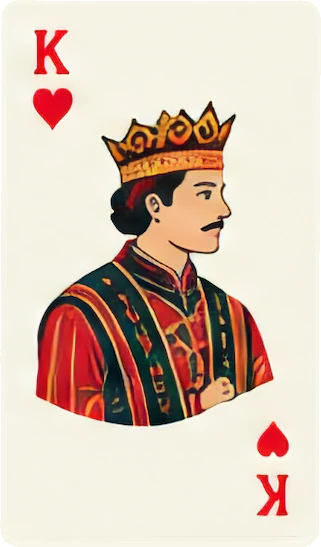
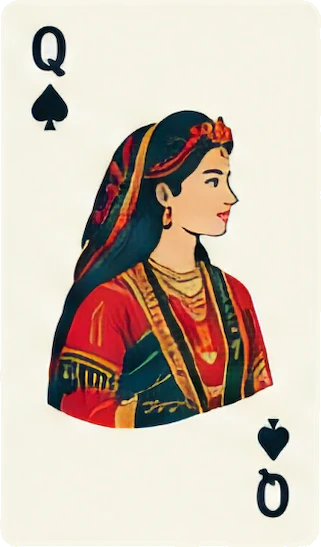
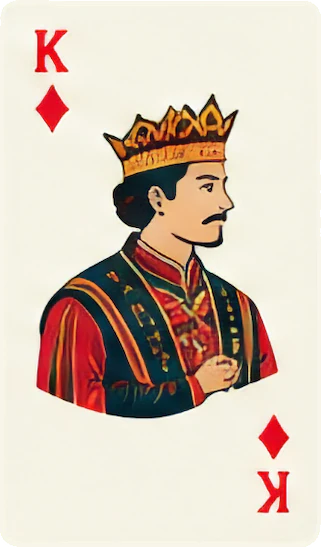
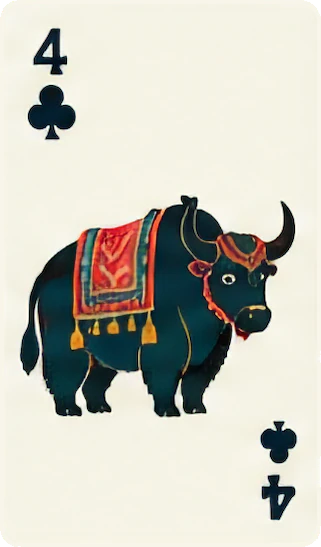
Runs, best first
- Q♠ K♥ A♦
- A♣ 2♦ 3♠
- J♥ Q♠ K♣
- 10♦ J♣ Q♥
- and so on, down to
- 2♠ 3♥ 4♦
K♠ A♥ 2♦ is not a run: a run can't turn the corner from king to two.
Trails, best first
- A♠ A♥ A♦
- K♠ K♥ K♦
- Q♠ Q♥ Q♦
- and so on, down to
- 2♠ 2♥ 2♦
Two hands of the same kind? The higher cards win, compared from the top (a pair by its pair first). Suits never break a tie.
A-K-Q and A-2-3 both count as runs, and by default A-K-Q is the top one. The host can put A-2-3 on top instead.
Pure sequence vs sequence: a pure sequence is all one suit and ranks just under a trail, so 2♥ 3♥ 4♥ beats Q♠ K♦ A♣.
What happens when two hands are the same type?
Two hands of the same type are compared by rank, and suits never break a tie.
- Trails and runs: the higher one wins, so K-K-K beats 9-9-9.
- Colours and high cards: compare the top card, then the next, then the last. A-7-3 beats K-Q-9.
- Pairs: the higher pair wins, then the odd card, so 8-8-K beats 8-8-5.
An exact tie goes to the player who did not ask in a show. In a sideshow the player who asked packs, and at the pot limit the pot is split.
What happens when you run out of chips
With fewer chips than the boot, you are not dealt in. Between hands you can buy in again or sit out.
- A new buy-in adds another stack at the same price, and it counts when you settle up.
- If you sit out, you can buy back in between any two hands.
- The host sets the buy-backs: unlimited (the default), none, or up to one, two, three or five. With none left, you watch.
Table options the host can set on Dashain
The host sets these when opening the table.
- Boot: 1 to 100 chips (10 by default).
- Buy-in: its price and chips ($10 for 1,000 chips by default).
- Buy-backs: unlimited, none or a set number.
- Blind turns: 2 to 6, or no limit (4 by default).
- Stake limit: a cap on raises (none by default).
- Pot limit: the pot at which everyone shows (1,024 boots by default, or none).
- Sideshow: on (the default) or off.
- Best run: A-K-Q (the default) or A-2-3.
- Seats: 2 to 8, plus a turn timer that reminds you but is not enforced.
Tips for new Faras players
Most of the skill in Faras is knowing when to look, when to pack and how much to bet.
- Most three-card hands are high card, so a pair is often good enough.
- Seeing doubles every bet after it, so a few blind turns save chips.
- Seen a weak hand? Pack early and keep your chips.
- Seen, with two left and your opponent blind? Nobody can call a show until they look, so count their blind turns.
Questions about Faras
Is Faras the same as Teen Patti?
Yes. Faras is the Nepali name for Teen Patti, the three-card game also called Flush or Flash. The hands, the blind and seen bets, the sideshow and the show work the same way, except that on Dashain both players must have seen their cards before a show.
What is the highest hand in Teen Patti?
A trail (three cards of the same rank) is the highest type of hand, and three aces (A-A-A) is the best trail. Below trails come pure sequence, sequence, colour, pair and high card.
Can a blind player ask for a sideshow?
No. You must have seen your cards to ask for a sideshow, and the player you ask (the one just before you) must have seen theirs too. On Dashain the same goes for a show: both of the last two players must have seen their cards.
What is the difference between a pure sequence and a sequence?
Both are three cards in a row, such as 5-6-7. A pure sequence is all one suit and ranks second, just under a trail. A sequence has mixed suits and ranks third, above a colour.
Is A-2-3 a sequence in Teen Patti?
Yes. A-2-3 and A-K-Q both count as sequences, but K-A-2 does not. On Dashain, A-K-Q is the highest run and A-2-3 the second, unless the host puts A-2-3 on top.
How much does a seen player bet in Teen Patti?
Twice the stake. With the stake at 10, a blind player bets 10 to chaal and a seen player bets 20.
Who wins a tie in a Teen Patti show?
Suits don't break ties, so two hands with the same ranks are an exact tie. In a show the player who did not ask wins, and in a sideshow the player who asked packs.
When can you ask for a show in Teen Patti?
Only when two players are left, and on Dashain only once you have both seen your cards. A blind player looks first, and nobody can ask a player who is still blind.
These are the rules as Faras plays on Dashain. The host can change some of them before the game starts. Updated .