
How to play Marriage
Marriage is a Nepali rummy game for two to five players, played with three decks and 21 cards each. You build sequences and sets, lay down three pure melds to see the maal (the valuable wild cards), then meld your whole hand to finish. Points come from winning and from the maal you hold.
Also called Marriage rummy, 21-card Marriage and Nepali Marriage.
- Players
- 2–5
- Cards
- 3 decks, plus up to 4 printed jokers
- Hand
- 21 cards each
- To see the maal
- 3 pure melds or 7 dublees
- To win
- Meld every card but your last throw
- Scoring
- Points, at a rate the host sets
What is the goal in Marriage?
Your goal is to be the first to meld your whole hand, while holding as much maal as you can. Marriage is a rummy game played across Nepal, and a favourite at family gatherings during Dashain and Tihar.
Each round has two stages. First you race to see the maal, which tells you which cards are wild and which score points. Then you use those wild cards to meld the rest of your hand.
How many cards are dealt in Marriage?
Each player is dealt 21 cards from three standard 52-card decks shuffled together. The host can also add up to three man cards and one superman card, so the full pack holds 156 to 160 cards.
- Man card
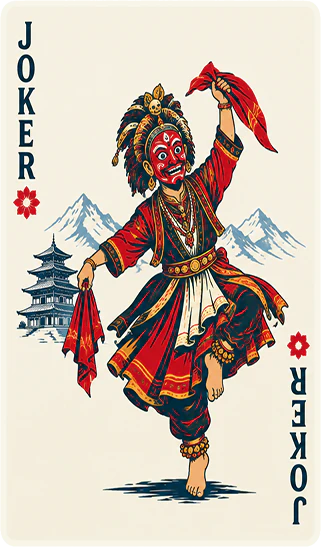
- A printed joker. It turns wild for you once you have seen the maal.
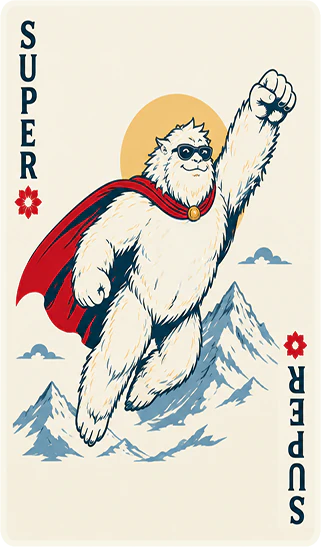
- Superman
- A special printed joker that is wild from the start of the round, before anyone has seen the maal.
- man cardMan cardUp to three in the pack
- supermanSupermanOne, if the host adds it
The dealer deals one card at a time, starting with the player after them. The next card goes face up to start the discard pile, and the rest are the stock. Play starts with the player after the dealer, and the deal moves one seat along each round.
What do you do on your turn?
On your turn you draw one card, then throw one card.
- Draw the top card of the stock, or pick up the top card of the discard pile.
- Arrange your hand into groups, by dragging cards or letting the table sort them.
- Throw one card face up onto the discard pile. You can't throw back a card you picked up from the pile this turn.
- If your hand now holds the melds to see the maal, the table waits while you show them or keep your hand.
When the stock runs out, the discard pile (except its top card) is shuffled to make a new stock.
What are sequences, tunnelas and dublees?
Sequences, tunnelas, trials and dublees are the melds of Marriage: the groups you build your hand into.
- Pure sequence
- Three or more cards in a row in one suit with no wild cards, such as 4♥ 5♥ 6♥. The ace can be low (A 2 3) or high (Q K A), but a run can't turn the corner (K A 2).
- Tunnela
- Three identical cards dealt to you, the same rank and the same suit, such as 7♠ 7♠ 7♠. Three man cards also make a tunnela. Three identical cards you draw into are a pure meld too, but no tunnela when the points are counted.
- Trial
- Three or four cards of the same rank in different suits, such as 7♠ 7♥ 7♣.
- Dublee
- A pair of identical cards, the same rank and the same suit, such as Q♦ Q♦. Two man cards also make a dublee.
Only pure sequences and tunnelas count toward seeing the maal. A wild card never completes a tunnela. Before you have seen, the only wild card is the superman, and a sequence it completes still counts as pure.
How do you see the maal?
You see the maal by laying down three pure melds, or seven dublees, beside your seat. From then on you are seen; until then you are unseen.
- Build three pure sequences or tunnelas, or seven dublees.
- Show them at the start of your turn, before you draw, or straight after your throw (never in between). They go face up beside your seat.
- If you are the first to see, the top card of the stock is turned over for you. That card is the tiplu, and it sets the maal for everyone. A man card or the superman can't be the tiplu: it goes under the stock and the next card is turned.
Only seen players can look at the tiplu. A tunnela dealt to you goes face up at once and counts as one of your three melds. Three man cards can go down as a tunnela, or stay in your hand as wild cards.
Seeing with seven dublees puts you on the dublee route: you finish with one more dublee, and you can't pick up a wild card from the discard pile.
What is maal? Tiplu, poplu, jhiplu and alter
The maal is the set of cards that score points and turn wild, and the tiplu decides which cards they are.
- Maal
- The cards that score at the end of a round: the tiplu's family, the man cards and the superman.
- Tiplu
- The card turned over when the first player sees the maal. It leaves play, and its two other copies are maal.
- Poplu
- One rank above the tiplu in the same suit. After the king comes the ace, then the 2.
- Jhiplu
- One rank below the tiplu in the same suit.
- Alter
- The tiplu's rank in the other suit of the same colour.
- Joker
- The tiplu's rank in the two suits of the other colour. Wild once you have seen, but worth no points.
- Marriage
- A tiplu, poplu and jhiplu held together. It scores more than the three cards alone.
Say the tiplu is 8♠. Its family and the jokers are then:
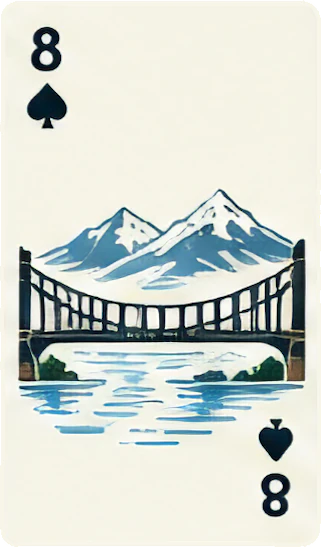
- 8♠TipluThe card turned over
- 9♠PopluOne above, same suit
- 7♠JhipluOne below, same suit
- 8♣AlterSame rank, same colour
- 8♥ 8♦JokersSame rank, other colour
- 7♠ 8♠ 9♠MarriageJhiplu, tiplu and poplu together
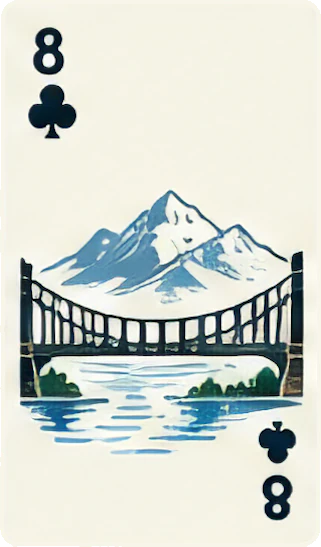
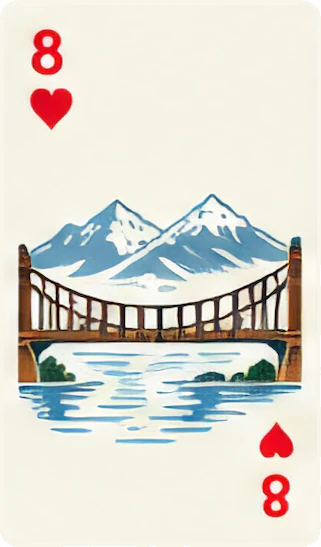
Once you have seen, all of these are wild for you, along with the man cards and the superman. A marriage counts wherever its three cards are, laid down or in your hand.
How do you finish a round?
You finish by melding every card in your hand except one, then throwing that card. Since you draw first, you meld 21 cards and throw the 22nd.
Once you have seen, any meld counts toward a finish: pure sequences, sequences and trials with wild cards, tunnelas, a marriage, or three or more wild cards together. On the dublee route you finish with an eighth dublee instead, and your other cards stay in your hand.
You can see the maal and finish on the same turn: lead with three pure melds and meld the rest, or lay down eight dublees.
How are points calculated in Marriage?
Points come from two places: what the other players pay the winner, and the maal settled between all the players.
- Count each player's maal with the tables below. An unseen player counts 0 for themselves (see Kidnap vs Murder).
- Add everyone's maal together.
- Maal points: your maal times the number of players, minus that total. It's the same as collecting the difference from each player with less maal and paying it to each player with more.
- Win points: each other player pays the winner 3 if they had seen the maal, or 10 if not. After a dublee finish, each pays 5 more.
| Card | 1 | 2 | 3 |
|---|---|---|---|
| Tiplu | 3 | 8 | – |
| Poplu | 2 | 5 | 10 |
| Jhiplu | 2 | 5 | 10 |
| Alter | 5 | 15 | 25 |
| Man card | 5 | 15 | 25 |
| Superman, kept to the end | 10 | – | – |
| Superman, in a sequence you showed | 5 | – | – |
| Joker | 0 | 0 | 0 |
| Marriage | 15 | 50 | – |
| Tunnela of | Points |
|---|---|
| Plain cards | 5 |
| Jokers | 10 |
| Poplus or jhiplus | 20 |
| Alters | 35 |
| Man cards | 35 |
| Bonus for two tunnelas | 5 |
| Bonus for three tunnelas | 35 |
| Other player | Normal finish | Dublee finish |
|---|---|---|
| Seen | 3 | 8 |
| Unseen | 10 | 15 |
| Player | Maal | Maal points | Win points | Total |
|---|---|---|---|---|
| Asha (winner) | 10 | +25 | +16 | +41 |
| Bikash (seen) | 5 | +5 | −3 | +2 |
| Chandra (seen) | 0 | −15 | −3 | −18 |
| Dipa (unseen) | 8, counts 0 | −15 | −10 | −25 |
A round's totals always add up to zero. The table keeps a running tally, and the host's rate per point turns it into money on the end screen.
Kidnap vs Murder: what happens to unseen maal?
Kidnap and Murder decide what happens to the maal of a player who never saw it.
- Murder (the default): their maal is void and counts as 0.
- Kidnap: the winner takes it, adding it to their own maal.
Either way, an unseen player still pays the winner 10 points and pays every seen player's maal. In the example above, Kidnap moves Dipa's 8 to Asha, so the maal that counts rises to 23.
| Player | Murder | Kidnap |
|---|---|---|
| Asha | +41 | +65 |
| Bikash | +2 | −6 |
| Chandra | −18 | −26 |
| Dipa | −25 | −33 |
What can the host set on Dashain?
The host chooses the rate, the mode, the printed jokers and a few table settings before the table opens.
| Option | Choices | Default |
|---|---|---|
| Dollars per point | $0.10, $0.25, $0.50, $1, $2, $5 or any amount (fixed once the table opens) | $1 |
| Game mode | Kidnap or Murder | Murder |
| Man cards | 0–3 | 3 |
| Superman card | 0 or 1 | 1 |
| Seats | 2–5 | 5 |
| Turn timer | Off, 30, 60 or 90 seconds (a reminder only) | Off |
| Cut for seats | On, or off for random seats and dealer | Off |
| Expert mode | On or off | Off |
Cut for seats has everyone cut a card: the highest picks a seat first and the lowest deals. Expert mode hides the meld hints and the Arrange button.
When the host ends the room, the end screen lists who pays whom in as few payments as possible. Dashain never handles money: you settle up among yourselves.
Tips for your first game of Marriage
Race to see the maal: it cuts what you pay the winner from 10 points to 3, and makes your maal count.
- Build pure sequences first. Trials don't help you see the maal.
- With five or six pairs from the deal, seven dublees may come faster than three sequences.
- Keep man cards. They turn wild once you have seen, and three dealt to you, laid as a tunnela to see the maal, score 35.
- Watch the discard pile. A card someone picks up tells you what they are building.
- Hosting a first game? Leave expert mode off so the table highlights melds.
Questions about Marriage
How many cards are dealt in Marriage?
Each player is dealt 21 cards from three standard decks shuffled together. On Dashain the host can also add up to three man cards and one superman card.
What is the maal in Marriage?
The maal is the tiplu's family (the tiplu, the poplu and jhiplu either side of it in its suit, and the alter, its rank in the other suit of the same colour) plus the man cards and the superman. Maal cards score points at the end of the round, and once you have seen the maal they are wild for you.
Can a joker be used before seeing the maal?
No. Before you see the maal the only wild card is the superman, if the host includes it. Man cards, the tiplu's family and the jokers turn wild for you only after you have seen.
How do you see the maal in Marriage?
Lay down three pure melds (pure sequences or tunnelas, with no wild cards) or seven dublees. A tunnela dealt to you counts as one of the three.
How are points calculated in Marriage?
Each player's maal points are their maal times the number of players, minus everyone's maal added together. On top of that, each other player pays the winner 3 points if they had seen the maal or 10 if they had not, plus 5 more after a dublee finish.
What is the difference between Kidnap and Murder in Marriage?
Both decide what happens to the maal of a player who never saw it. In Murder it counts for nothing; in Kidnap the winner takes it.
What is a tunnela in Marriage?
A tunnela is three identical cards dealt to you, the same rank and the same suit. It counts as a pure meld for seeing the maal and scores from 5 to 35 points, depending on the card, with a bonus of 5 for two tunnelas and 35 for three. Three identical cards you draw into also count as a pure meld, but score only as the cards in them.
What is a dublee in Marriage?
A dublee is a pair of identical cards, the same rank and the same suit, or two man cards. Seven dublees see the maal, and an eighth finishes the round, with 5 extra points from each other player.
These are the rules as Marriage plays on Dashain. The host can change some of them before the game starts. Updated .