
How to play Ludo
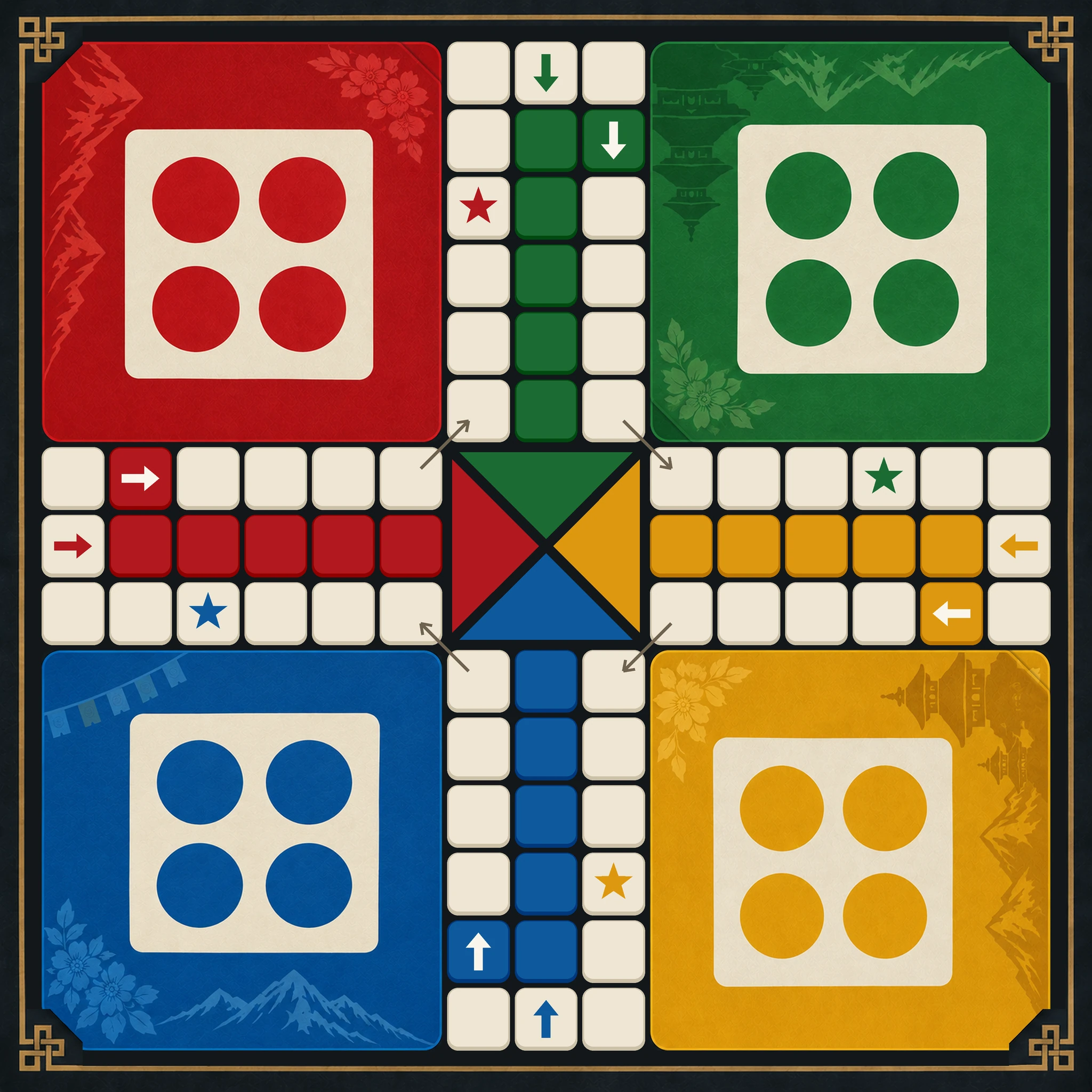
Ludo is a race for two to four players. Each player has four tokens in a yard. Roll a six to bring one out, then move clockwise round the board and up your home column. Land on a rival to send them back. The first to get all four tokens home wins.
Also called Ludo King, Pachisi and Ludo board game.
- Players
- 2–4
- Formats
- Everyone alone, or 2 v 2
- Tokens
- 4 each
- Dice
- One, rolled each turn
- A game
- Played on for 1st, 2nd and 3rd
- View
- Top-down 2D or 3D
What is the aim of Ludo?
Get all four of your tokens from your yard, once round the board and into home, the triangle in the middle, before everyone else. With more than two players the game plays on after the winner, until 2nd and 3rd are decided.
Ludo grew out of the Indian game Pachisi and is played in homes across Nepal and South Asia, where house rules vary. This guide follows the game as it plays on Dashain, close to Ludo King's classic rules.
How is the Ludo board laid out?
The board is a cross of squares with a coloured yard in each corner: red, green, yellow and blue. A track of 52 squares runs clockwise round the cross, shared by everyone.
Each colour has a start square just outside its yard, and a home column of five squares of its own colour leading to the middle. Only your own tokens may enter your home column.
With two players you sit opposite each other, red against yellow, so both of you have the same distance to run.
Ludo words to know
You will meet these words at the board and in these rules.
- Yard
- Your corner, where your four tokens wait at the start and after they are captured.
- Start square
- The square outside your yard where a token comes onto the track. It is safe.
- Star
- A safe square marked with a star, eight squares on from each start.
- Home column
- The five squares of your colour that lead from the track to home.
- Home
- The triangle of your colour in the middle of the board, where tokens finish.
- Capture
- Landing on a rival's token and sending it back to its yard. Also called cutting or killing.
How does a turn work in Ludo?
- Roll the dice.
- Pick one of your tokens and move it that many squares, clockwise. The tokens that can move glow, and you see where each would land.
- If only one move is possible it is made for you. If none is, your turn passes.
- Roll again if you rolled a six, captured a token or brought a token home.
You must move if you can, and you can't split a roll between two tokens. Two of your tokens on the same square move one at a time.
Do you need a six to start in Ludo?
Yes. A token leaves the yard only on a six, and goes onto your start square. Bringing a token out uses the six, and you roll again.
The host can switch on the Nepali rule, Out on a 1 or 6. Then a one also brings a token out, and a one also gives another roll.
When do you roll again, and what about three sixes?
- Rolling a six (or a one with the Nepali rule) gives another roll.
- Capturing a token gives another roll.
- Bringing a token home gives another roll.
- A move earns one extra roll at most, even if it does two of these at once.
A third six in a row ends your turn at once, without moving. The moves you made with the first two sixes stand.
How do you capture in Ludo?
End your move on a square where a rival's token stands and it goes back to its yard, to start again with a six. Passing over a token does nothing: only landing counts.
Two tokens of one colour on the same square are no wall. They can be passed, and landing on them captures both.
Which squares are safe in Ludo?
Eight squares are safe: the four start squares and the four stars. Nobody can be captured there, and tokens of different colours can share them. Your home column is safe too, since nobody else can enter it.
How do you get a token home?
After going once round the board, a token turns off the track into your home column, and needs the exact number to reach home. With a token three squares from home you need a three; a bigger roll can't move it, so move another token instead.
How does Ludo doubles (2 v 2) work?
With four players the host can play doubles: two teams of two, with partners sitting opposite. Partners never capture each other and can share a square.
Once all four of your tokens are home you keep rolling on your turns and move your partner's tokens instead. Your team wins when all eight tokens are home.
How do you win Ludo?
The first player with all four tokens home wins. With three or four players the rest play on for 2nd and 3rd, and the last one left places last. A game of two ends with its winner. Then tap Rematch for another game, with the first roll moving one seat on.
Questions about Ludo
Do you need a six to get out in Ludo?
Yes, in classic Ludo a token leaves its yard only on a six. On Dashain the host can also switch on the Nepali rule, where a one brings a token out too.
What happens if you roll three sixes in Ludo?
Your turn ends at once without moving on the third six. The moves you made with the first two sixes stand.
Can you capture a token on a star?
No. The stars and the four start squares are safe: nobody is captured there, and tokens of different colours can share them.
Do two tokens on one square make a block?
Not in these rules. Two tokens of one colour can be passed, and landing on them sends both back to their yard.
Do you need an exact roll to get home in Ludo?
Yes. A token in its home column needs the exact number to reach home, so with a bigger roll you move another token instead.
Do you get an extra turn for capturing in Ludo?
Yes. Capturing a token, bringing a token home or rolling a six each gives you another roll, though one move earns one extra roll at most.
These are the rules as Ludo plays on Dashain. The host can change some of them before the game starts. Updated .