

How to play Jhyaap (Dhumbal)
Jhyaap, also called Dhumbal or Jhyap, is a Nepali card game for two to six players. Everyone holds five cards and takes turns throwing cards and picking one back to get their hand's points as low as possible. Call Jhyap when your hand is worth 10 or less: if yours is lowest, everyone pays you.
Also called Dhumbal and Jhyap.
- Players
- 2–6
- Deck
- One 52-card deck, no jokers
- Cards each
- 5
- Card values
- Ace 1 to king 13
- Call Jhyap at
- 10 or less (host can change)
- Scoring
- Points, with a dollar value per point
What is the goal of Jhyaap?
The goal of Jhyaap is to hold the lowest hand at the table and call Jhyap before anyone can beat you. Every card is worth points, and your hand is worth the total of its cards.
You start with five cards and bring the total down by throwing cards and picking one back. When your hand is worth 10 or less, you can call Jhyap. If nobody else is as low, everyone pays you their points. If someone is, you pay.
How are the cards dealt in Jhyaap?
Each player gets five cards from one standard 52-card deck, with no jokers. Two to six people can play.
The dealer deals one card at a time, starting on their left, until everyone has five. The next card is turned face up: it is the first card on offer. The rest of the deck sits face down as the draw pile.
The player on the dealer's left goes first, and play carries on round the table. After each hand the deal passes one seat along, to the player who went first, whoever won.
How much is each card worth in Jhyaap?
Each card is worth its number, with the ace as 1 and the jack, queen and king as 11, 12 and 13. Suits don't change the points.
- A♣Ace1 point
- 7♦2 to 10Face value: this one is 7
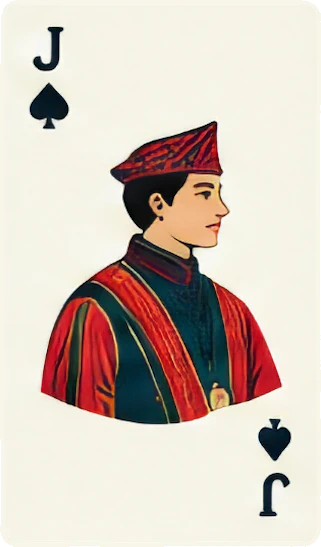
- J♠Jack11 points
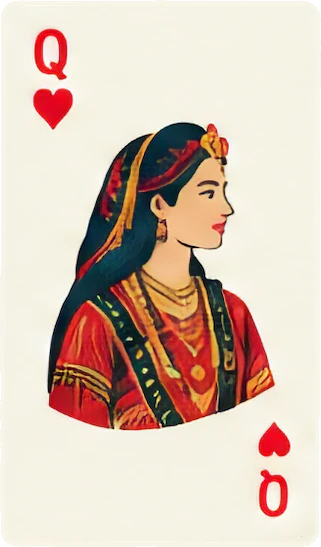
- Q♥Queen12 points
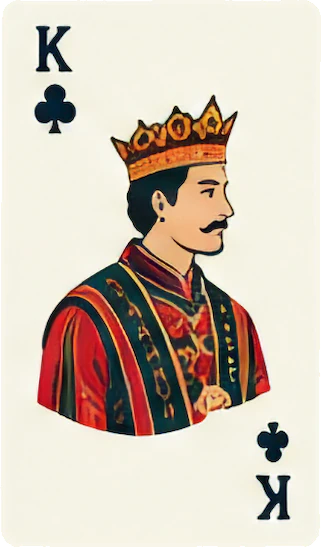
- K♣King13 points
Your hand is worth the total of its cards: A♣ 2♦ 3♠ 4♥ make 10, while K♠ alone is worth 13. On Dashain your total shows beside your cards as you play.

How does a turn work in Jhyaap?
On your turn you throw first, then pick one card back.
- Throw a single card, a set or a run from your hand.
- Pick one card: the top of the face-down deck, or one card from the previous player's throw. The first player of a hand picks from the card turned up after the deal.
- Play passes on. The rest of the previous throw goes out of play, and your throw is what the next player picks from.
You can't pick up your own throw. From a single or a set on offer you may take any card. From a run you may take only one of its two end cards, never one from the middle.
If the deck runs out, the cards that went out of play are shuffled into a new deck.
What can you throw in Jhyaap?
You can throw one card, two or more cards of the same rank, or three or more cards in a row in one suit.
- 9♣SingleAny one card
- 9♠ 9♦SetTwo, three or four of one rank, in any suits
- 4♥ 5♥ 6♥RunThree or more in a row, all one suit
- A♠ 2♠ 3♠Run from the aceThe ace is low in a run

The ace is low only, so Q♠ K♠ A♠ and K♠ A♠ 2♠ are not runs. Nor are two cards in sequence (5♠ 6♠, say), or a sequence in mixed suits.
Throwing several cards shrinks your hand, because you still pick only one back. Throw a set of three from five cards and you hold three. Fewer cards usually means fewer points.
When can you call Jhyap?
You can call Jhyap at the start of your turn, before you throw, when your hand is worth 10 points or less. The host can change that limit.
- Call on your own turn, before you throw. Once you have thrown, you wait for your next turn.
- Your hand must be at or under the limit. With the default limit of 10, a hand worth 10 can call and a hand worth 11 can't.
- Nobody can call until every player has had one turn, unless the host allows Jhyap in the first round.
Calling ends the hand straight away. Every hand is turned face up and the points are counted.
How does scoring work, and what if you call Jhyap and lose?
If your hand is the lowest when you call, every other player pays you the points in their own hand. If anyone is as low as you or lower, your call is beaten: the lowest hand wins, and you pay that player the points of every other hand, your own included.
- A tie goes against the caller.
- If several players tie for lowest, the first of them after the caller in turn order wins.
- On a beaten call, nobody but the caller and the winner scores.
| Player | Hand | Asha calls (wins) | Chandra calls (beaten) |
|---|---|---|---|
| Asha | 6 | +44 | +44 |
| Bikash | 14 | −14 | 0 |
| Chandra | 9 | −9 | −44 |
| Dipa | 21 | −21 | 0 |
When Asha calls with 6, each player pays her their own hand: 14 + 9 + 21 = 44. When Chandra calls with 9, Asha's 6 beats her. Asha still collects 44, but Chandra pays all of it: her own 9, Bikash's 14 and Dipa's 21. At $0.05 a point, 44 points is $2.20.
Points go on a running tally for the table, and the host deals the next hand. When the table ends, the end screen shows who pays whom in dollars. Dashain never handles money: you settle up among yourselves.
Which Jhyaap options can the host set on Dashain?
The host sets the dollars per point, the calling limit, first-round Jhyap, the number of seats and a turn timer. The dollar value can't change once the table opens.
| Option | Choices | Default |
|---|---|---|
| Dollars per point | $0.01, $0.05, $0.10, $0.25, $0.50, $1 or any amount (0 plays for points only) | $0.05 |
| Call Jhyap at | 5, 7, 10, 12 or 15 or less | 10 or less |
| Jhyap in the first round | On, or off so nobody calls until everyone has had a turn | Off |
| Seats | 2 to 6 | 4 |
| Turn timer | Off, 15, 30 or 60 seconds, as a reminder only | Off |
A lower limit makes for longer hands. A higher one allows earlier calls, with more chance that someone is lower.
Tips for winning at Jhyaap
Get rid of big cards, keep your hand small, and call only when you are confident nobody can match you.
- Throw high cards early. A king left in your hand costs 13 points if someone else calls.
- Keep pairs and near-runs to throw together. Two 8s thrown as a set clear 16 points and a card.
- A low card in the throw on offer often beats a blind draw from the deck, but everyone sees what you take.
- Watch the card count by each seat. A player down to one or two cards may be close to calling.
- Think twice before calling right on the limit. A beaten call can cost far more than a win would bring.
Jhyaap terms and what they mean
These are the words you will hear at a Jhyaap table.
- Jhyap
- The call that ends the hand, made when your hand is at or under the limit.
- Dhumbal
- Another name for Jhyaap.
- Throw
- The single, set or run you put down at the start of your turn.
- Pick
- The one card you take back after throwing, from the deck or the previous throw.
- Set
- Two or more cards of one rank.
- Run
- Three or more cards in sequence in one suit, ace low.
- Limit
- The most your hand can be worth when you call: 10 unless the host changes it.
- Hand value
- The total points of the cards in your hand.
Questions about Jhyaap
Is Jhyaap the same as Dhumbal?
Yes. Jhyaap (also spelled Jhyap) and Dhumbal are names for the same card game, in which you lower a five-card hand by throwing and picking, then call when it is worth 10 or less.
What is the Jhyap limit?
The limit is the most your hand can be worth when you call Jhyap. It is 10 by default, so you can call with 10 points or less. On Dashain the host can set it to 5, 7, 10, 12 or 15.
How much is an ace worth in Dhumbal?
An ace is worth 1 point, the lowest card in the deck. Number cards are worth their number, and the jack, queen and king are worth 11, 12 and 13.
What happens if someone has a lower hand when you call Jhyap?
Your call is beaten. The player with the lowest hand wins, and you pay them the points of every other hand at the table, your own included. The other players pay nothing that hand.
What happens if you tie when you call Jhyap?
A tie counts against the caller. If another player's hand is worth the same as yours, they win and you pay them the points of every other hand, including yours.
Can you call Jhyap on your first turn?
Not by default: nobody can call until every player has had one turn. The host can switch on Jhyap in the first round to allow it.
Can the ace be high in a Jhyap run?
No. The ace is low only, so A-2-3 of one suit is a run but Q-K-A and K-A-2 are not. A run needs three or more cards in sequence, all in the same suit.
Can you pick up the card you just threw?
No. After you throw, you pick either the top card of the deck or one card from the previous player's throw. From a run you can take only one of its two end cards.
These are the rules as Jhyaap plays on Dashain. The host can change some of them before the game starts. Updated .